
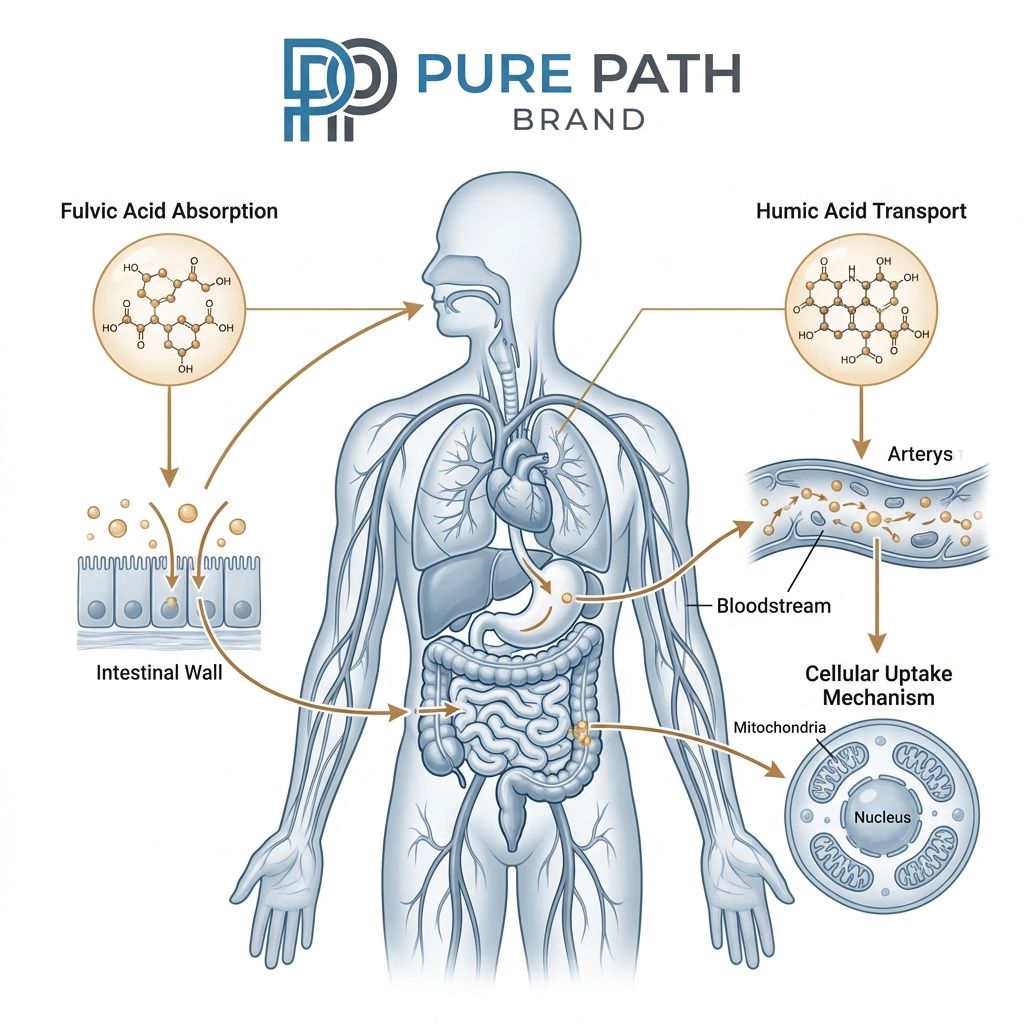
Membrane transport is the process by which molecules cross the lipid bilayer that surrounds every cell in the body. Understanding this barrier is key to understanding why some supplements work and others do not.
The Cell Membrane as Gatekeeper
Every cell is wrapped in a phospholipid bilayer — a double layer of fat molecules that creates a selective barrier. Small, uncharged, or lipid-soluble molecules can diffuse through relatively easily. Large, charged, or highly polar molecules (like mineral ions) cannot cross without help.
How Minerals Cross
Mineral ions (Mg²⁺, Zn²⁺, Fe²⁺) are charged and water-soluble — the exact properties that make membranes resist them. Nature solved this with transport proteins (channels, pumps) and with chelation by organic acids that mask the charge and create a lipid-friendly complex. Fulvic acid does the second thing.
Why Molecular Size Matters
Fulvic acid works as a membrane transport agent because it is small (typically <10,000 Daltons) and amphiphilic — it has both water-loving and lipid-friendly regions. This lets it interact with the membrane surface AND carry chelated minerals through. Humic acid, being much larger, does not cross — which is precisely why it stays in the gut as a binder. See Heavy Metal Binding Explained.
Relevance to Supplementation
If a supplement cannot cross cell membranes, it circulates in blood plasma but never enters cells where it is actually used. Fulvic acid's role is to address this last-mile delivery problem — getting nutrients not just into the bloodstream, but into the cell interior. See Cellular Delivery Explained.
These statements have not been evaluated by the FDA. Educational content, not medical advice.