
RESEARCH · EVIDENCE GUIDE
Fulvic Acid: Evidence, Uses, Limitations, and Safety
An educational overview of what fulvic acid is, where the evidence is stronger or weaker, practical consumer uses, and safety boundaries — written for readers and publishers, not as a treatment manual.
Scope: Dietary-supplement education. Not medical advice. Not intended to diagnose, treat, cure, or prevent any disease. Pure Path Northwest sells fulvic products — see conflict notes in the Transparency Report.
Contents
- What fulvic acid is
- Evidence map (stronger → weaker)
- Common non-medical uses people discuss
- Limitations and open questions
- Safety, interactions, and who should pause
- Quality checklist for buyers
- Fulvic vs humic vs shilajit (brief)
- How to cite
1. What fulvic acid is
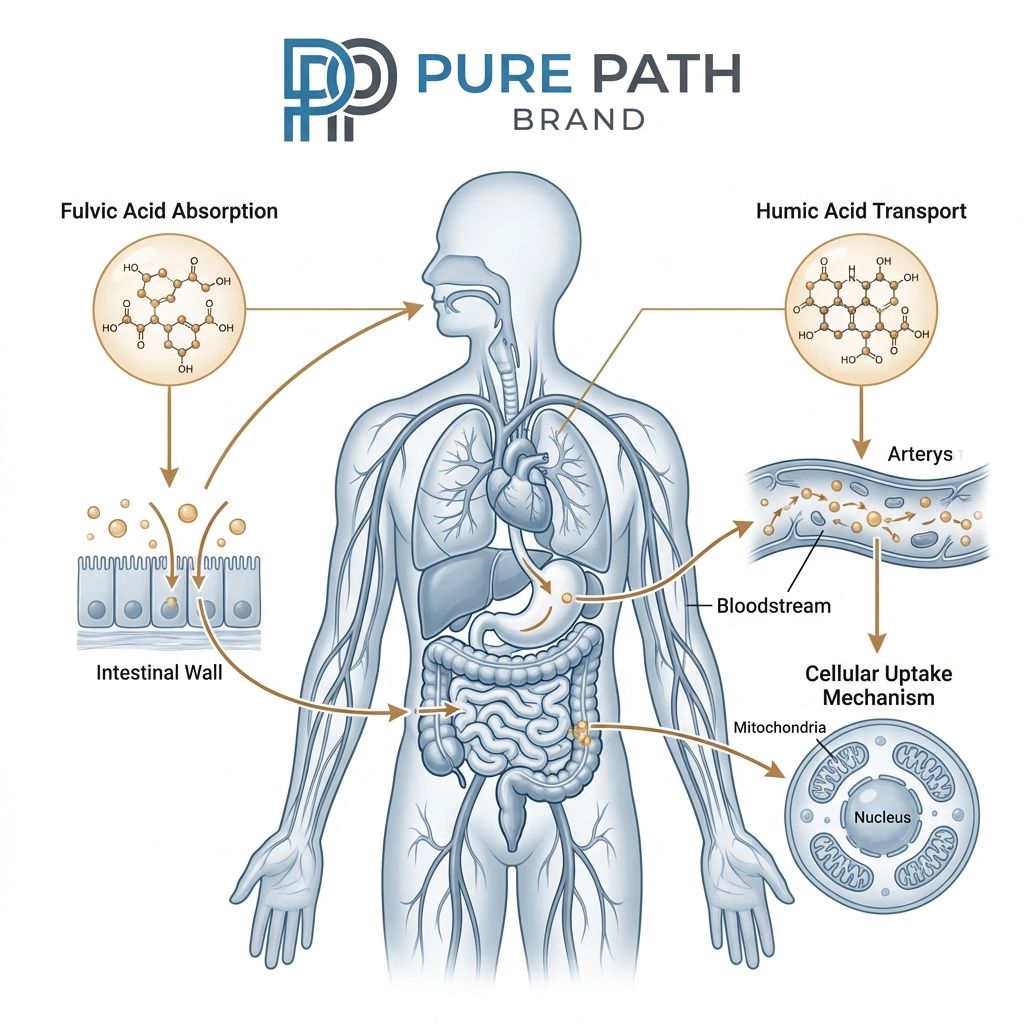
Fulvic acids are a family of low-molecular-weight organic acids formed during long-term decomposition of plant matter in soils and humate deposits. In geochemistry and agricultural science they are studied as components of humic substances that influence mineral solubility and transport in soils and water.
In consumer supplements, “fulvic acid” usually means a standardized extract (liquid or powder) marketed as a mineral-related delivery or electrolyte-adjacent product. Labels vary widely in assay method, concentration, and whether humic fractions are blended in.
For a mechanism-oriented primer on this site, see What Is Fulvic Acid? and Bioavailability.
2. Evidence map (stronger → weaker)
Publishers should match claim strength to evidence type. The table below is a map, not a license to overstate outcomes.
| Topic | What is relatively better supported | What is often overstated | Practical reading |
|---|---|---|---|
| Chemistry / chelation behavior | Humic substances (including fulvic fractions) have well-described carboxyl and phenolic groups that complex metal ions in environmental and lab chemistry contexts. | Guaranteed “X× absorption” for every mineral in every human after every commercial powder. | Mechanism language is fair; bare multiples need named primary studies and product-specific data. See claims sheet. |
| Agricultural / environmental literature | Decades of soil and plant research on humic substances and nutrient availability. | Direct transfer of plant-uptake results into human clinical claims without bridging trials. | Useful background; not a human health endpoint by itself. |
| Human clinical outcomes | Limited, heterogeneous, often small or condition-specific studies in the broader humic/fulvic literature; quality and relevance vary. | Disease treatment, detox cures, guaranteed energy/lab transformations from a retail SKU. | Do not market disease claims. Prefer self-tracking of subjective markers if users choose to experiment. |
| Product quality variance | Category quality is inconsistent; extraction and testing disclosure matter. Independent testing narratives in the market report large content variance across brands. | “99% of products are fake/dead” as a census statistic without a named audit. | Use checklist language (COA, metals, source, extraction). See Transparency Report. |
| Separated fulvic vs blended resins | Product architecture can separate fulvic-oriented and humic-oriented SKUs for different timing (e.g., AM/PM protocols). | Implies clinical superiority solely because SKUs are separate. | Separation is a design/disclosure fact; efficacy still needs appropriate evidence. |
3. Common non-medical uses people discuss
- Stack “delivery layer” experiments — taking a fulvic product away from large meals while running an existing mineral or supplement routine, then watching subjective markers.
- Hydration / mineral routine adjunct — as part of a morning fluid habit (not a replacement for electrolytes prescribed for medical needs).
- Protocol structure — short, time-boxed trials (e.g., 10 days) with written scores rather than open-ended “feel better” anecdotes. Try the free Path 10-Day Protocol Tracker.
- Occupational wellness education — trades-oriented content about exposure load is context, not a workplace medical program.
None of the above is a diagnosis pathway. Track sleep, stress, training, and diet confounds.
4. Limitations and open questions
- Assay non-uniformity: “Fulvic content” on labels is not always measured the same way across labs.
- Heterogeneous material: Fulvic fractions are mixtures, not a single drug-like molecule with one dose-response curve.
- Human RCT gaps: Many commercial claims outrun product-specific controlled trials.
- Confounding: Hydration, caffeine withdrawal, training deloads, and placebo effects swamp weak signals.
- External validity: Lab chelation ≠ gut lumen behavior ≠ tissue delivery in a specific person.
5. Safety, interactions, and who should pause
General caution (educational, not exhaustive):
- Pregnant or nursing people, children, and anyone with significant kidney, GI, or absorption disorders should involve a clinician before use.
- If you take prescription drugs with narrow therapeutic windows, ask a pharmacist/clinician about timing relative to mineral binders or chelating materials.
- Stop and seek care for concerning symptoms (severe GI distress, rash, dizziness, etc.).
- Heavy-metal content testing of a product is not the same as a medical chelation protocol.
- Prefer lot-matched COAs; avoid unlabeled powders from unknown supply chains.
Pure Path product pages and the FAQ reiterate FDA disclaimer language. Path AI tools are educational software, not clinicians.
6. Quality checklist for buyers
- Is the fraction named (fulvic vs humic vs blend vs shilajit resin)?
- Is extraction method disclosed (cold/aqueous vs heat/chemical)?
- Is source geography and chain-of-custody discussed?
- Can you get a lot-matched COA with metals method and date?
- Can you compute price per labeled serving of the named material?
- Are outcome claims modest and cited — or absolute and medical?
Work the full matrix in the 2026 Transparency Report.
7. Fulvic vs humic vs shilajit (brief)
- Fulvic: smaller fraction; often discussed in delivery/solubility contexts.
- Humic: larger fraction; often discussed in binding/complexation contexts in the gut-lumen education on this site — see What Is Humic Acid?.
- Shilajit: crude mountain resin that may contain fulvic material plus other constituents; authenticity and contaminant questions are category issues — see Pure Path vs Shilajit.
8. How to cite
Albert, D. (2026). Fulvic Acid: Evidence, Uses, Limitations, and Safety. Pure Path Northwest. https://purepathnorthwest.com/research/fulvic-acid-evidence-guide
Related: Transparency Report · Claims Substantiation · Media Kit · dannyalbert.com